
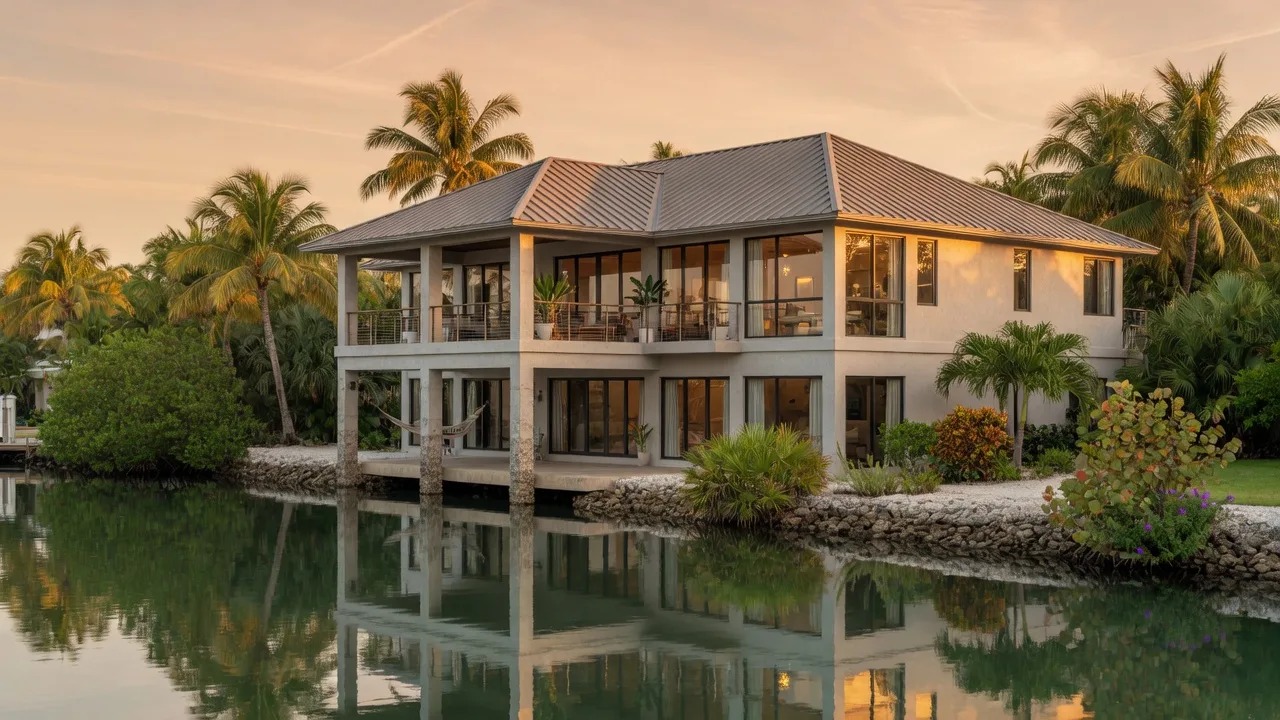
Built to Withstand: How Storm-Resilient Construction Drives Luxury Value in the Florida Keys
In the Keys, how a luxury waterfront home is built is part of what it is worth. Here is how elevation, impact glass, and roof strapping protect value and command a premium.
Key Takeaways
- The Florida Keys sit in the highest wind-design zone in the state, with requirements for elevation, impact-resistant openings, and roof-to-wall connections.
- Elevation on engineered pilings, at or above the base flood elevation plus freeboard, is the single most important resilience feature on Keys waterfront property.
- Impact-resistant windows and doors, plus hurricane-rated roof strapping, are part of the building standard in the Keys' wind-borne debris region.
- These features also lower insurance cost and risk, which is why resilient construction consistently commands a premium over non-hardened homes.
- For buyers, reading the resilience of a home is as important as reading the view, and it is where contractor-level expertise pays off.
In the Florida Keys, a luxury waterfront home is only as valuable as it is well built for the weather it will meet. Storm resilience is not a compromise, it is a feature that protects both your asset and your lifestyle, and it is built into the very best homes at a premium. As a licensed Contractor and Home Inspector who has evaluated waterfront property across the entire island chain, I want to explain how elevation, impact glass, and roof strapping drive real value in this market.
The Keys carry the highest wind-design speeds in Florida, and Monroe County sits in a wind-borne debris region where exterior openings face the strictest standards in the state. New construction here is governed by the Florida Building Code and Monroe County floodplain and coastal construction rules, and the result is a housing stock that, at its best, is genuinely engineered to stand up to a hurricane. Understanding what that engineering looks like is essential for any serious luxury buyer.
Elevation Is the Foundation of Resilience
The single most important resilience feature on a Keys waterfront home is elevation. Homes are built on engineered, deeply embedded pilings so that storm surge passes beneath them rather than through them. Building codes require residential structures to be elevated to the base flood elevation plus freeboard, and seaward of the Coastal Construction Control Line, the bottom of the lowest horizontal structural member must sit above the design flood level, with enclosed lower floors limited to parking, storage, and recreational use.
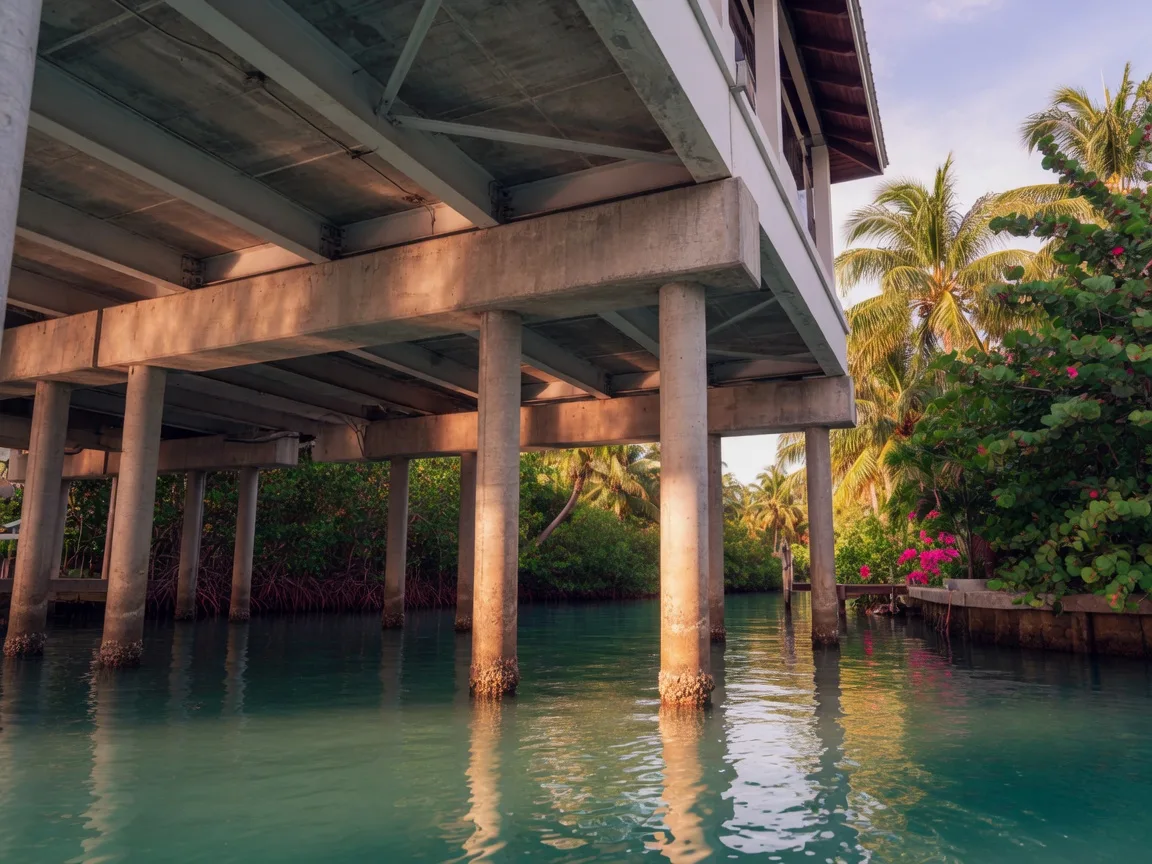
That elevation also carries a practical insurance story. A properly elevated home with the right elevation certificate is cheaper to insure, and insurance is one of the biggest recurring costs of Keys waterfront ownership. For a buyer, confirming the elevation certificate and understanding the design flood elevation is not paperwork, it is value. Our insurance and flood zone guide explains how this drives your annual cost.
Impact Glass and the Wind-Borne Debris Standard
Because the Keys are a wind-borne debris region, every exterior opening, windows, doors, skylights, and garage doors, must be impact-resistant or protected by an approved opening-protection system. In the highest-performing homes that means true impact glass with Florida Product Approval, often specified with Miami-Dade tested assemblies, so that wind-driven debris cannot breach the envelope. A home with impact glass and hurricane shutters is not only safer, it is more comfortable year-round and easier to insure.
When you walk through a listing, look at the windows and doors the way a contractor does: check for impact ratings, inspect the hardware and seals, and confirm the opening-protection system is current and complete. This is exactly the kind of due diligence that separates a hardened luxury home from one that looks the part but has not kept up. My contractor's guide to evaluating a Keys waterfront home walks through what to check and how to read it.
Roof Strapping and the Structural Chain
The roof is the part of a home most exposed to a hurricane, and Florida law requires roof-to-wall connectors, commonly called hurricane straps or clips, in new residential construction statewide. In the Keys, those metal connectors must be engineered for the extreme uplift forces of the region's 180 to 185 mile per hour design winds, tying the roof framing to the walls and down to the foundation.
The point of the whole system is a continuous structural chain, from the roof down through the walls and into the pilings. A break anywhere in that chain is a weak point. For a buyer, the question is not just whether the home looks strong, but whether its structural elements are properly connected and rated. That is precisely why I bring a contractor's eye to every property I represent, and why it matters for the value you are paying for. Our complete waterfront inspection checklist covers the full set of items to verify.
The Dock and Seawall Are Part of the System
On a waterfront property, resilience does not stop at the house. The seawall and the dock are load-bearing parts of the whole asset, and a compromised seawall or tired dock can undermine a home that is otherwise well built. A settling or undercut seawall threatens the very ground the structure stands on, while a failing dock and boat lift become expensive, safety-critical projects the next owner inherits.
This is why the most sophisticated luxury buyers treat the marine infrastructure as part of the resilience question, not a separate afterthought. They confirm whether the seawall is concrete, riprap, or natural shoreline, and they look for settling, cracks, and undercutting at the waterline. They verify that the dock and boat lift use marine-grade materials and are properly permitted, and they check the elevation of the structure against the flood risk. Our seawall and dock inspection guide and analysis of waterfront infrastructure value cover this ground in depth.
Because the Keys sit in the highest wind zone in the state, and much of the coastline falls under Monroe County's coastal construction rules, the best homes here are engineered as one continuous system: deep pilings in the ground, an elevated living floor, an impact-resistant envelope, a strapped roof, and a sound seawall and dock tying the marine side together. When all of those elements are present and maintained, the property is genuinely built to withstand, and it trades accordingly.
Why Resilience Commands a Premium
Storm-resilient construction protects value in three ways. It lowers risk and insurance cost, it reduces the chance of expensive storm damage, and it keeps a home livable and marketable in a market where buyers increasingly ask the resilience question first. For all of those reasons, a hardened, elevated luxury home consistently trades at a premium over a non-hardened home, and the gap only widens as buyers become more sophisticated.
This is also why new construction and thoughtful renovation can be such a strong investment in the Keys. A home built or rebuilt to the modern standard, with elevation, impact glass, and a continuous structural chain, is a home that holds its value through the cycle. Our guide to luxury renovation and new construction looks at what a well-executed build is worth, and our analysis of waterfront infrastructure value connects the marine side of that equation.
Reading a Home Like an Investor
The best luxury buyers in the Keys do not just see a beautiful home, they see a well-engineered asset. They ask about elevation and the elevation certificate, impact ratings, roof connections, and the condition of the seawall and dock. Those answers are where the premium lives, and they are where the risk is hidden when a home has not been maintained.
The same logic applies whether you are buying a finished estate or land for a new build. On a new build, the modern code standard is already baked into the design, which is a large part of why well-executed new construction holds its value so well in this market. On an existing home, the resilience question is a due diligence question: what year was it built, what upgrades have been made, and does the paperwork prove the elevation, the impact ratings, and the structural connections? A home that cannot show its hardening is priced on hope, while a home that can is priced on certainty.
That certainty is what separates a confident purchase from a speculative one. It is also what lets a buyer sleep well through storm season, which, for a second home or a full-time home in paradise, is worth a great deal on its own. Resilience is not just a financial feature, it is peace of mind, and in the Florida Keys that peace of mind is part of the luxury.
For a broader view of how the Upper Keys market prices quality and scarcity, read our investment case for luxury waterfront property in the Upper Keys and the current Florida Keys market report. And when you are ready to evaluate a specific property, the right team will read its resilience as carefully as its view. The complete buyer's guide ties the whole process together, from the first question to the keys in hand.
The homes that define the Keys luxury market are the ones that pair beauty with strength: elevated, hardened, and maintained, with the paperwork to prove it. That combination is rare enough to command a premium and durable enough to protect it, which is exactly what a discerning buyer should want from a long-term waterfront asset. When you find that home, you are not just buying a view, you are buying certainty in one of the most beautiful, and most weather-tested, places on earth.

Steve Conley
Principal, Conley Sales Group at COMPASS, the exclusive Compass office in the Florida Keys. Licensed Sales Associate, Contractor, and Home Inspector with over 30 years in the Keys market.
Full BioStorm-resilient luxury
what to know.
What makes a Florida Keys waterfront home storm-resilient?
The most important features are elevation on engineered pilings, impact-resistant windows and doors, and hurricane-rated roof-to-wall connections. Together they form a continuous structural chain designed for the Keys' extreme wind zone.
Do impact windows and doors pay for themselves in the Keys?
Yes. Impact-resistant openings meet the wind-borne debris standard, lower insurance cost, and protect the home during storms. They are a meaningful part of the premium a well-built luxury home commands.
Why does elevation matter so much for waterfront property?
Elevation on deep pilings lets storm surge pass beneath the living space, protects the home, and lowers flood insurance cost through a stronger elevation certificate. It is the single most important resilience feature.
How can a buyer verify a home is genuinely hardened?
Review the elevation certificate, confirm impact ratings and Florida Product Approval on the windows and doors, inspect roof-to-wall connectors, and have a licensed contractor or home inspector evaluate the full structural chain and seawall.
Does storm-resilient construction really drive resale value?
Yes. Resilient homes cost less to insure, face less storm risk, and appeal to sophisticated buyers, so they consistently command a premium and hold their value through the market cycle.
Helpful Resources & Related Guides
Continue your research on luxury waterfront construction and investment in the Florida Keys with these guides.
Internal Resources
Thinking About Buying or Selling
in the Florida Keys?
Steve Conley brings 30 years of Keys expertise, $1.4 billion in career sales, and contractor-inspector credentials to every transaction. Start with a conversation.
Connect with Steve