
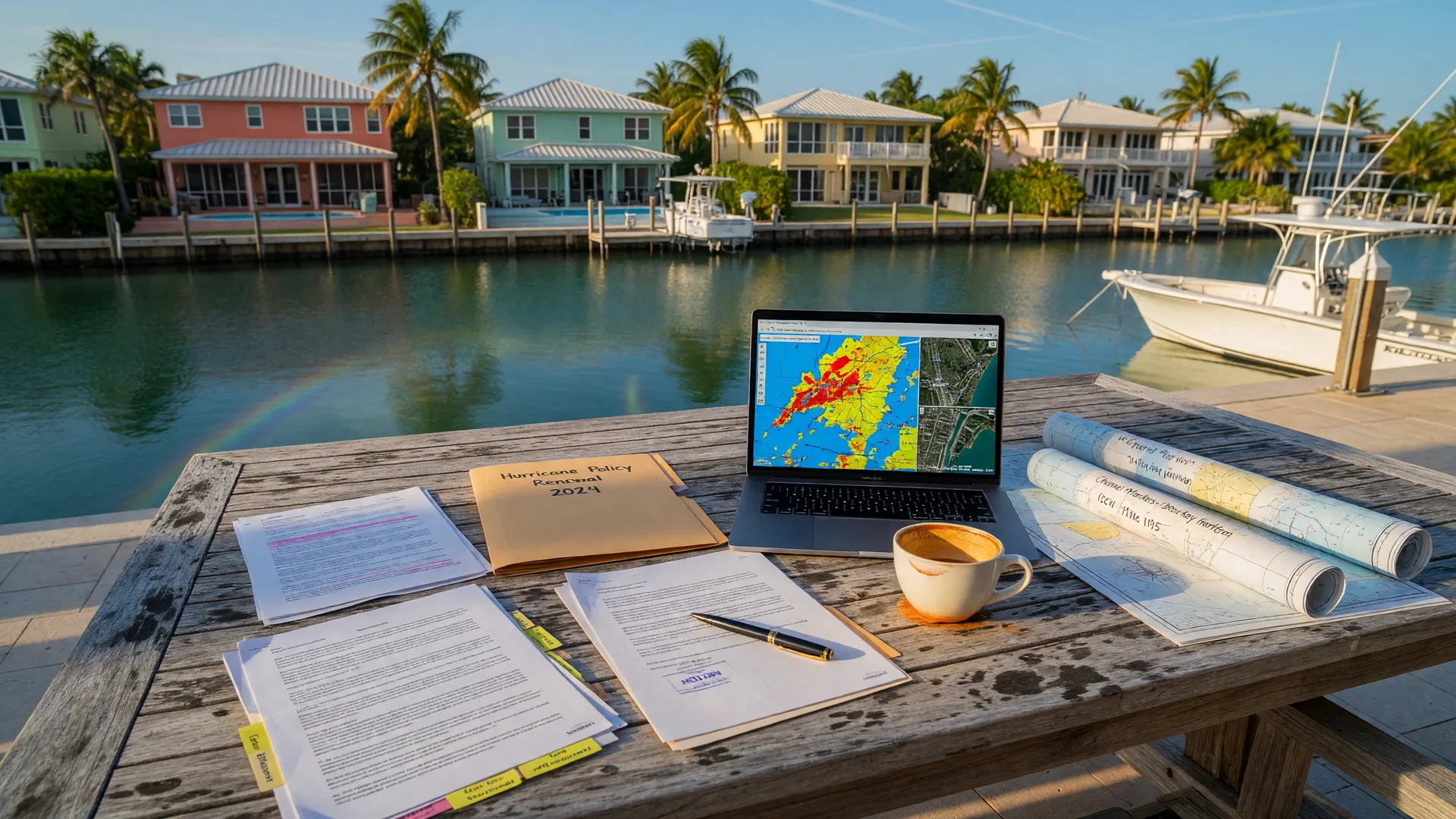
Understanding Insurance and Flood Zone Requirements When Buying a Florida Keys Waterfront Home
Insurance is one of the most complex and costly aspects of Florida Keys homeownership. Understanding how flood zones, elevation certificates, and wind mitigation affect your costs is essential before making an offer.
Key Takeaways
- Florida Keys waterfront buyers need two insurance policies: flood insurance (through NFIP or private market) and windstorm insurance (through Citizens or private carriers), and the combined cost can range from $8,000 to $40,000 or more per year depending on the property.
- The elevation certificate is the single most important document for determining flood insurance costs. It establishes the relationship between the lowest floor elevation and the base flood elevation, and it directly determines your flood zone classification and premium.
- Wind mitigation features such as impact windows, hip roof geometry, and secondary water resistance can reduce windstorm premiums by 30 to 50 percent compared to properties without these features.
- Understanding flood zone designations (V, A, AE, X) is essential for evaluating both insurance costs and design requirements, as each zone carries different building standards and premium implications.
- Getting insurance quotes early in the buying process and factoring them into your total cost of ownership prevents surprises at closing and ensures you choose a property that fits your budget long-term.
Of all the complexities involved in buying a Florida Keys waterfront home, insurance is the one that surprises buyers most often. It is not unusual for a first-time Keys buyer to fall in love with a property, negotiate a price, and then discover that the combined cost of flood and windstorm insurance is $25,000 or more per year. That is a carrying cost that directly affects the affordability of the property, and it is one that many buyers do not consider until late in the process. As a licensed Sales Associate, Contractor, and Home Inspector, I have spent three decades helping buyers navigate this landscape. This guide covers everything you need to know about insurance and flood zone requirements before you make an offer.
The Florida Keys are one of the most expensive places in the United States to insure a home, for good reason. The island chain is exposed to hurricanes, storm surge, and rising sea levels, and insurance carriers price that risk accordingly. But the range of outcomes is wide. A well-elevated property with modern impact windows and a favorable wind mitigation report might pay $8,000 to $12,000 per year for combined coverage, while a similar property with lower elevation and fewer mitigation features could pay $25,000 to $40,000 or more. Understanding what drives those differences is essential to making a smart purchase decision.
Understanding Flood Zones
Flood zones are geographic areas defined by FEMA that reflect the level of flood risk for a given location. In the Florida Keys, nearly every property is in a designated flood zone, but the specific designation makes a significant difference in both insurance requirements and building standards.
V zones (velocity zones) are the highest-risk areas, typically along the oceanfront and open bayfront where wave action can exceed three feet during a storm event. Properties in V zones are subject to the most stringent building standards, including elevated foundations designed to allow water to pass beneath the structure. Insurance premiums in V zones are the highest in the Keys.
A zones (including AE and AH designations) are areas subject to rising water during flood events but without the high-velocity wave action of V zones. Most canal-front properties in the Keys fall into A zones. Insurance costs in A zones are lower than in V zones but still significant.
X zones are areas of moderate to low flood risk. Some properties in the Keys, particularly those on higher ground away from the immediate coastline, may be in X zones, which carry the lowest flood insurance costs. However, true X zone properties are rare in the Keys, and most lenders still require flood insurance for properties in X zones if they have a federally backed mortgage.
To determine a property's flood zone designation, you need the elevation certificate for that specific property. For a deeper look at the complete evaluation process, see my Complete Florida Keys Waterfront Property Inspection Checklist.
The Elevation Certificate: Your Most Important Document
The elevation certificate is a FEMA document prepared by a licensed surveyor that establishes the relationship between a property's lowest floor elevation and the base flood elevation (BFE). This document is the foundation of the flood insurance rate calculation, and it is the single most important piece of paper in any Florida Keys waterfront transaction.
The elevation certificate shows the following information.
- The elevation of the lowest floor (including the top of the slab for elevated structures) relative to the National Geodetic Vertical Datum.
- The base flood elevation for the property's location, which is the elevation that floodwaters are expected to reach during a 100-year flood event.
- The difference between the lowest floor elevation and the BFE, which determines the flood insurance premium.
- The flood zone designation for the property.
If the lowest floor elevation is at or above the BFE, the property is considered compliant with flood zone requirements and will qualify for the most favorable insurance rates available in its zone. If the lowest floor is below the BFE, the property is considered non-compliant, and insurance rates will be significantly higher. In some cases, non-compliant properties may not qualify for certain types of coverage at all.
I review elevation certificates as a standard part of my property evaluations. This is one of the advantages of working with an agent who holds contractor and inspector credentials: I can identify potential issues with the elevation certificate before they become obstacles to financing or insurance placement.
Wind Mitigation and Its Impact on Premiums
While flood insurance addresses the risk of rising water, windstorm insurance addresses the risk of hurricane-force winds. Windstorm coverage in Florida is typically provided by Citizens Property Insurance Corporation, the state-backed insurer of last resort, or by a growing number of private carriers that have entered the Florida market in recent years.
The cost of windstorm insurance is determined primarily by a property's wind mitigation features, which are documented in a wind mitigation report prepared by a certified inspector. The report identifies the following features.
- Roof geometry. Hip roofs (sloped on all four sides) perform better in high winds than gable roofs and qualify for the largest premium discounts.
- Roof cover attachment. The method used to attach the roof covering to the deck determines how well the roof will resist wind uplift.
- Secondary water resistance. A layer of self-adhering membrane beneath the roof covering provides protection if the primary covering is damaged.
- Opening protection. Impact-rated windows and doors, or hurricane shutters, protect the building envelope from wind-borne debris.
- Roof-to-wall connections. The connectors that tie the roof structure to the walls determine the overall structural integrity of the building in high winds.
The difference in windstorm premiums between a property with optimal mitigation features and one with minimal features can be dramatic. A property with hip roof geometry, impact windows throughout, and a secondary water resistance barrier might pay 30 to 50 percent less for windstorm coverage than a comparable property with a gable roof, no impact protection, and standard roof attachment.
As a licensed Contractor and Home Inspector, I evaluate wind mitigation features as part of my standard property assessment. I can identify which features are present, estimate the potential insurance savings, and advise my clients on whether upgrading mitigation features would be a worthwhile investment. For a comprehensive walkthrough of the full buying process, read my guide to Navigating the Florida Keys Luxury Home Buying Process.
Getting Insurance Quotes Early
One of the most common mistakes Keys buyers make is waiting until they are under contract to start exploring insurance costs. By then, the flood insurance and windstorm rates are a known cost that must be absorbed, regardless of whether they fit the buyer's budget. The smarter approach is to get insurance quotes for any property you are seriously considering before making an offer.
A qualified insurance agent who specializes in Florida coastal properties can provide a preliminary quote based on the property's address, elevation certificate, and basic construction details. The quote will not be binding until the carrier reviews the full documentation, but it will give you a realistic picture of what the property will cost to insure.
When comparing properties, factor the insurance cost into your total monthly carrying cost. A property with a lower purchase price but higher insurance costs may end up being more expensive overall than a property with a higher purchase price and lower insurance costs. The total cost of ownership is what matters, not just the purchase price.
Insurance Considerations for Different Property Types
The type of property you buy has a significant impact on insurance requirements and costs. Here is how different property types typically compare.
Canal-front homes in A zones generally have lower flood insurance costs than open-water properties in V zones, assuming comparable elevation. The canal provides some protection from wave action, and the flood zone designation reflects that. However, canal homes with lower elevation or older construction may still face significant premiums.
Oceanfront and bayfront homes in V zones carry the highest flood insurance costs due to the risk of storm surge and wave action. The elevation certificate is particularly important for these properties, as even a small difference in lowest floor elevation can translate into thousands of dollars in annual premium savings.
New construction and substantially renovated properties benefit from the most favorable insurance rates, as they are built to current codes that require modern wind mitigation features and elevated living spaces. Many insurance carriers offer new construction discounts that can save buyers thousands of dollars per year.
Older properties with original construction may face higher insurance costs, but they can often be significantly improved through retrofitting. Adding impact windows, upgrading roof attachments, and installing secondary water resistance can reduce windstorm premiums and improve the property's insurability. For a guide to how these factors affect renovation decisions, see our guide to Luxury Waterfront Renovation and New Construction.
The Total Cost of Ownership
When evaluating a Florida Keys waterfront property, the total cost of ownership includes far more than the mortgage payment and property taxes. Insurance is typically the second or third largest line item in the monthly budget, and it can vary dramatically from one property to the next.
Here is a realistic example. A well-elevated canal home in Key Largo with modern impact windows and hip roof geometry might have a combined flood and windstorm premium of $9,000 to $12,000 per year. An oceanfront property on a lower lot in a V zone with minimal mitigation features might cost $25,000 to $35,000 per year or more. That difference of $15,000 to $25,000 per year is real money that affects both your monthly cash flow and the long-term investment return on the property.
I tell my clients to always get insurance quotes before making an offer. It is a simple step that prevents costly surprises and ensures that the property you choose fits your budget in the long run. For a comprehensive overview of all the factors that affect the buying process, visit our How to Buy a Luxury Second Home in the Florida Keys guide and our Florida Keys Luxury Real Estate Market Report.
How I Help Buyers Navigate Insurance and Flood Zone Complexity
My background as a licensed Sales Associate, Contractor, and Home Inspector gives me a unique ability to evaluate insurance-related factors as part of my property assessments. When I review a property with a client, I do the following.
- Review the elevation certificate and explain what it means for insurance costs and building requirements.
- Evaluate the wind mitigation features and estimate the insurance premium implications.
- Identify potential issues that could affect insurability, such as a lowest floor that is below the base flood elevation or a roof that lacks impact protection.
- Provide realistic cost estimates for any improvements that would reduce insurance costs, such as upgrading windows or adding secondary water resistance.
- Coordinate with insurance agents to get preliminary quotes before my clients make an offer.
Insurance is not the most glamorous part of buying a Florida Keys waterfront home, but it is one of the most important. Getting it right from the start ensures that your dream home does not become a financial burden. For personalized guidance on finding the right property for your budget and lifestyle, contact Steve Conley today. I would be honored to help you navigate every aspect of the Keys buying process.

Steve Conley
Principal, Conley Sales Group at COMPASS the exclusive Compass office in the Florida Keys. Licensed Sales Associate, Contractor, and Home Inspector. Over 30 years and $1.4 billion in career sales serving Key Largo to Key West.
Full BioInsurance and flood zones:
what to know.
What is the difference between a V zone and an A zone in the Florida Keys?
V zones (velocity zones) are the highest-risk flood areas, typically along oceanfront and open bayfront where wave action exceeds three feet during storms. Properties in V zones require elevated foundations and pay the highest flood insurance premiums. A zones (including AE and AH designations) are subject to rising water but not high-velocity wave action. Most canal-front properties in the Keys fall into A zones, which carry lower insurance costs than V zones while still requiring flood coverage. The elevation certificate is the definitive document for determining a property's specific flood zone designation and associated costs.
How much does homeowners insurance cost for a Florida Keys waterfront home?
Combined flood and windstorm coverage for a Florida Keys waterfront home typically ranges from $8,000 to $15,000 per year for a well-elevated property with modern wind mitigation features, and $20,000 to $40,000 or more for properties with lower elevation, older construction, and fewer mitigation features. The cost depends on the flood zone, elevation certificate, wind mitigation report, age of construction, and distance from the coast. Getting quotes from an agent specializing in Florida coastal properties is essential before making an offer.
Can I get flood insurance for any property in the Keys?
Most properties in the Keys qualify for flood insurance through the National Flood Insurance Program (NFIP) or private market carriers, but the cost varies dramatically depending on the property's elevation certificate and flood zone designation. Properties where the lowest floor is below the base flood elevation may face significantly higher premiums or may not qualify for standard NFIP coverage. In these cases, private market flood insurance may be available, but at a higher cost. The elevation certificate is the key document that determines insurability and cost, which is why I review it as a standard part of my property evaluations.
What wind mitigation features save the most on insurance?
The three wind mitigation features that produce the largest premium discounts are hip roof geometry (sloped on all four sides), impact-rated windows and doors or approved hurricane shutters, and a secondary water resistance barrier beneath the roof covering. A property with all three features can qualify for premium reductions of 30 to 50 percent compared to a property with a gable roof, unprotected openings, and no secondary water resistance. Other important factors include the quality of roof-to-wall connections and the method of roof cover attachment.
Should I get insurance quotes before making an offer on a Keys property?
Absolutely. Getting insurance quotes before making an offer is one of the most important steps in the Keys buying process. The cost of insurance can vary by $10,000 or more per year between two similar-looking properties, and that difference directly affects both your monthly budget and the long-term investment return on the property. A qualified insurance agent who specializes in Florida coastal properties can provide preliminary quotes based on the property's address, elevation certificate, and construction details. I always recommend that my clients obtain these quotes early, and I help coordinate the process as part of my standard service.
Helpful Resources & Related Guides
Deepen your understanding of the Florida Keys home buying process with these related resources.
Internal Resources
- How to Buy a Luxury Second Home in the Florida Keys
- Navigating the Florida Keys Luxury Home Buying Process
- Seawall and Dock Inspection Guide for Florida Keys Buyers
- How to Evaluate a Florida Keys Waterfront Home: Contractor's Guide
- Florida Keys Luxury Real Estate Market Report
- Contact Steve Conley for Personalized Buying Guidance
Thinking About Buying or Selling
in the Florida Keys?
Steve Conley brings 30 years of Keys expertise, $1.4 billion in career sales, and contractor-inspector credentials to every transaction. Start with a conversation.
Connect with Steve