
How to Evaluate a Florida Keys Waterfront Home: A Contractor's Guide to Structural Due Diligence
Buying a waterfront home in the Florida Keys requires more than a standard home inspection. Here is a licensed contractor's guide to evaluating what really matters.
Key Takeaways
- A standard home inspection covers only the house. Evaluating a waterfront property requires specialized inspections of the seawall, dock, elevation certificate, and wind mitigation features.
- The seawall is the most expensive component to repair or replace, with costs ranging from $500 to $1,000 or more per linear foot. A failing seawall can cost $40,000 to $120,000 to replace on a typical residential lot.
- Elevation certificates and wind mitigation reports determine insurance costs, which can vary by thousands of dollars per year between properties with similar market values.
- Working with a buyer's agent who holds contractor and inspector licenses means you get a comprehensive structural evaluation without coordinating multiple specialists.
- Understanding the total cost of ownership including insurance, HOA fees, maintenance reserves, and potential infrastructure repairs is essential before making an offer.
Buying a waterfront home in the Florida Keys is not like buying a house on the mainland. The difference is not just in the price. It is in the layers of infrastructure that make a waterfront property functional, safe, and valuable. The house itself is only half the equation. The seawall, the dock, the elevation, the wind mitigation features, and the flood zone classification are equally important, and they require specialized knowledge to evaluate properly.
As a licensed Sales Associate, Contractor, and Home Inspector with over three decades in the Florida Keys, I have evaluated hundreds of waterfront properties from a structural perspective. This guide walks you through the due diligence process that I use for every client. It covers the key areas that a standard home inspection will miss, and it explains how to evaluate each one before you make an offer.
The Seawall: Your Most Important Investment
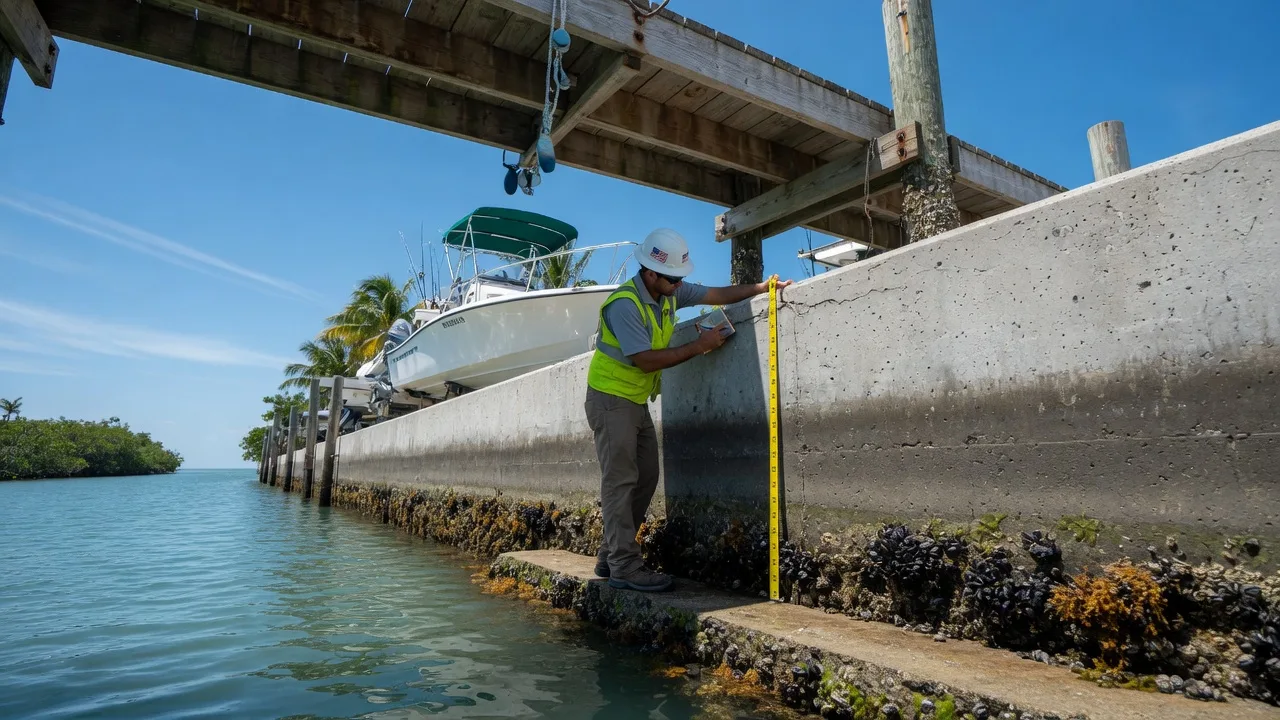
The seawall is the single most critical structural element of any Keys waterfront property. It holds back the land, protects your property from erosion, and defines the boundary between your yard and the water. A seawall in good condition is invisible to the untrained eye. A failing seawall is a financial problem waiting to happen.
Seawalls in the Florida Keys are typically constructed of one of three materials. Concrete seawalls are the most common in newer construction, consisting of reinforced concrete panels with tie-back rods anchored into the soil. Steel sheet pile walls offer excellent strength but are susceptible to corrosion in saltwater. Vinyl sheet pile walls are corrosion-resistant but may not be suitable for all soil conditions.
Here is what I look for when evaluating a seawall.
- Cracks and fractures. Horizontal cracks near the top of the wall often indicate that the wall is being pushed outward by soil pressure behind it. Vertical cracks may indicate differential settlement or localized stress.
- Tilting or bulging. A wall that leans forward or bulges outward is actively failing. The degree of tilt indicates how urgent the repair or replacement is.
- Corrosion of tie-back rods. The tie-back rods that anchor the wall into the soil are vulnerable to corrosion at the connection point. A failed tie-back rod can allow the wall to rotate forward.
- Scour at the base. Erosion of the soil at the base of the wall on the water side undermines the wall's foundation and accelerates failure.
- Separation at joints. Gaps between concrete panels indicate movement and potential failure of the interlocking system.
For a complete guide to evaluating seawalls and docks, read my Seawall and Dock Inspection Guide.
The Dock: Your Connection to the Water
The dock is where you will spend a significant portion of your time as a waterfront property owner. It is also a complex structure that requires careful evaluation. A dock that is structurally sound, electrically safe, and positioned over adequate depth adds significant value to a property. A dock with problems can be dangerous and expensive to repair.
When I evaluate a dock, I start with the structural components. The pilings should be in good condition, free of significant rot, marine borer damage, or corrosion. The stringers and decking should be sound, with no soft spots or signs of deterioration. The age of the dock is a useful indicator: pressure-treated timber docks typically last 15 to 25 years in saltwater before needing significant repairs or replacement.
Electrical safety is a critical concern. The National Electrical Code requires ground-fault protection on all dock circuits, and the electrical equipment must be rated for marine environments. I check the dock for proper wiring, code-compatible receptacles, and corrosion-free connections. Faulty dock electrical systems are a serious safety hazard and should be addressed before closing.
Depth at the dock face is equally important. I recommend getting a recent depth survey that shows the water depth at the dock at mean low water. This survey will confirm whether the dock can accommodate your vessel now and in the future. For a deeper look at how dock infrastructure affects property value, read my guide to deep-water canal investment in Key Largo.
Elevation Certificates and Flood Zones
Every waterfront property in the Florida Keys has an elevation certificate that documents the relationship between the lowest floor elevation and the base flood elevation. This document is essential for determining flood insurance requirements and costs, and it should be reviewed carefully before making an offer.
The elevation certificate tells you the property's flood zone designation (V, A, or X), the elevation of the lowest floor, and whether the property complies with local floodplain management regulations. Properties in V (velocity) zones, where wave action can exceed three feet, have the most stringent requirements and the highest insurance costs. Properties in A zones have lower requirements but still require flood insurance. Properties in X zones are outside the high-risk flood area and have the lowest insurance requirements.
I review elevation certificates as a standard part of my property evaluations. A property with a well-documented elevation certificate that shows the lowest floor well above the base flood elevation is worth more than a comparable property with marginal elevation, because the insurance costs will be lower and the risk profile is more favorable.
Wind Mitigation: Insurance Cost Driver
A wind mitigation report documents the features that reduce a property's vulnerability to wind damage. These features include impact-resistant windows and doors, hip roof geometry, secondary water resistance, and proper shutter systems. A property with strong wind mitigation features can qualify for significant discounts on windstorm insurance, often 30 to 50 percent below properties without these features.
The wind mitigation report should be prepared by a licensed inspector and should document each feature with photographs and measurements. I verify that the features documented in the report actually exist on the property, and I help clients understand how the report affects their insurance costs.
The difference in insurance costs between a well-mitigated property and one without mitigation features can be thousands of dollars per year. For luxury properties with high replacement costs, the savings can be even more significant. Understanding wind mitigation is essential for accurately modeling the total cost of ownership.
HVAC, Electrical, and Plumbing in Salt Air
The salt air of the Florida Keys is hard on mechanical systems. HVAC equipment that might last 15 to 20 years in a mainland environment may need replacement after 10 to 12 years in the Keys. The same is true for electrical panels, exterior outlets, and metal plumbing components.
When I evaluate a property's mechanical systems, I look for signs of salt-air corrosion that go beyond normal wear. HVAC units should be inspected for coil corrosion, cabinet rust, and proper operation. Electrical panels should be checked for corrosion of bus bars and breakers. Plumbing systems should be evaluated for pinhole leaks and galvanic corrosion at connections between dissimilar metals.
For a complete inspection checklist covering every system in a Keys waterfront home, read my Complete Florida Keys Waterfront Property Inspection Checklist.
The Total Cost of Ownership
When evaluating a waterfront property, I help my clients model the total cost of ownership, not just the purchase price. This includes the following.
- Insurance. Combined flood and windstorm coverage typically costs $8,000 to $15,000 per year for a well-elevated, well-mitigated property. Properties with lower elevation or fewer mitigation features may pay $20,000 to $40,000 or more.
- HOAs and canal maintenance. Neighborhood and canal maintenance fees can range from a few hundred to several thousand dollars per year, depending on the community and the condition of the canal infrastructure.
- Seawall and dock reserves. Even a seawall in good condition will need eventual replacement. Setting aside funds for this eventuality is a prudent part of any waterfront property budget.
- Mechanical system replacement. HVAC, electrical, and plumbing systems in the Keys have shorter lifespans than their mainland counterparts due to salt-air exposure.
Understanding these costs before making an offer ensures that you are making an informed decision. The property with the lowest purchase price is not always the best value when you factor in the total cost of ownership.
For personalized guidance on evaluating waterfront properties and navigating the buying process, contact Steve Conley for a confidential consultation. I bring the perspective of a licensed contractor, home inspector, and real estate agent to every evaluation, ensuring that you have the information you need to make a confident decision. You can also visit our comprehensive buyer's guide for a step-by-step walkthrough of the entire process.

Steve Conley
Principal, Conley Sales Group at COMPASS the exclusive Compass office in the Florida Keys. Licensed Sales Associate, Contractor, and Home Inspector. Over 30 years and $1.4 billion in career sales serving Key Largo to Key West.
Full BioStructural due diligence:
what to know.
What is the most expensive repair a Florida Keys waterfront property can need?
Seawall replacement is the most expensive single repair a waterfront property can require. Costs range from $500 to $1,000 or more per linear foot, meaning a typical residential seawall of 80 to 120 linear feet can cost $40,000 to $120,000 or more to replace. Dock replacement is the second most expensive, typically $15,000 to $40,000 depending on size and materials. These costs underscore the importance of a thorough evaluation before purchase, which is why I examine seawall and dock condition on every property I represent.
Do I need a separate inspection for the dock and seawall?
Yes. A standard home inspection does not cover the seawall or dock. You need a marine contractor or engineer to evaluate these structures from both the land and water sides. The dock requires a structural inspection and an electrical safety evaluation. The seawall requires a visual inspection of the wall face, tie-back system, and scour condition. When I represent a buyer, I perform these evaluations as part of my standard service, drawing on my contractor and inspector licenses. This saves my clients the time and expense of coordinating separate inspections and ensures that nothing is missed.
What is an elevation certificate and why does it matter?
An elevation certificate is a document prepared by a licensed surveyor that shows the elevation of a property's lowest floor relative to the base flood elevation. It determines the property's flood zone classification and directly affects flood insurance requirements and costs. A property with a lowest floor that is well above the base flood elevation will have lower insurance premiums than one with marginal elevation. I review elevation certificates as a standard part of my property evaluations because they have a direct impact on the total cost of ownership.
What wind mitigation features should I look for?
The most impactful wind mitigation features are impact-resistant windows and doors (with proper product approval numbers), hip roof geometry (a roof with sloped sides on all four corners), secondary water resistance (a self-adhering membrane under the roof covering), and code-compliant shutter systems. A property with all of these features can qualify for the maximum insurance discounts, often 30 to 50 percent less than an unprotected property. The wind mitigation report must be prepared by a licensed inspector and should document each feature with photographs and measurements.
Can I use a standard home inspector, or do I need a Keys specialist?
I strongly recommend using an inspector who specializes in Florida Keys waterfront properties. The Keys have unique requirements including flood zone compliance, elevation verification, wind mitigation documentation, and salt-air corrosion evaluation that a mainland inspector may not be familiar with. A Keys specialist will know what to look for and will understand the local building codes and regulations. Better yet, work with a buyer's agent who holds contractor and inspector licenses, as I do, so that you get a comprehensive evaluation of both the house and the waterfront infrastructure from a single professional.
Helpful Resources & Related Guides
Deepen your understanding of the Florida Keys waterfront home evaluation and buying process with these related resources.
Internal Resources
- How to Buy a Luxury Second Home in the Florida Keys
- Seawall and Dock Inspection Guide for Florida Keys Waterfront Buyers
- The Complete Florida Keys Waterfront Property Inspection Checklist
- Canal vs. Open-Water Waterfront Property: A Luxury Investment Guide
- Florida Keys Luxury Real Estate Market Report
- Contact Steve Conley for Personalized Buying Guidance
Thinking About Buying or Selling
in the Florida Keys?
Steve Conley brings 30 years of Keys expertise, $1.4 billion in career sales, and contractor-inspector credentials to every conversation. Let him guide you to the right property at the right price.
Connect with Steve