
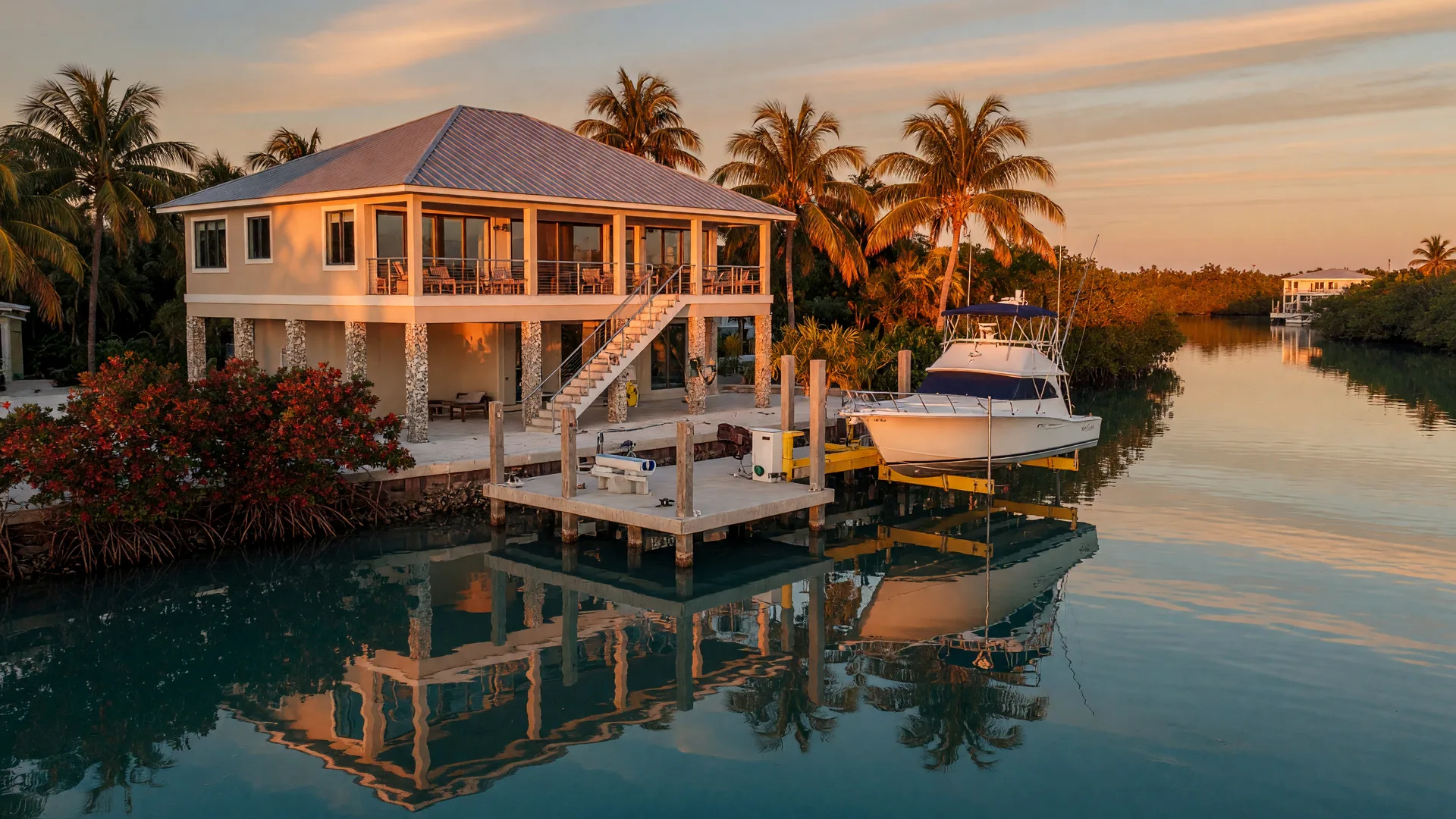
Buying a Florida Keys Waterfront Home for Your Boat: A Buyer's Guide to Dockage, Draft, and Deep-Water Access
In the Keys, the boat is part of the address. Here is how to run the buying process in the right order, from your boat's numbers to the depth survey, so the home you close on actually fits the vessel you own.
Key Takeaways
- Know your boat's numbers before you tour: length, draft, beam, and weight set the bar for dock length, canal depth, and boat lift capacity.
- Canal depth is measured at mean low water, and it is the single biggest value variable in the Keys: five feet or more floats serious yachts, while shallow canals limit you to smaller boats.
- The seawall and dock are structural assets, not afterthoughts. A failing seawall is a six-figure repair, and the dock must be built for your boat's length and your lift's weight.
- Boat lifts, davits, and dockage rules live under HOA and ARCO review, so confirm what you can keep at the house before you fall for the property.
- Make water depth part of the offer: a depth-survey contingency protects you, and hurricane-season planning for the boat belongs in the budget from day one.
Most people shop for a Florida Keys waterfront home by falling in love with the house and then hoping the water works out. That is the expensive way to do it. The boat is part of the address here, and the buying process should start with your boat's numbers: length, draft, beam, and weight. Those four figures decide which canals fit you, which docks can hold you, and which lifted slips can store you. This guide walks through the process in the right order so the Keys home you close on truly fits the vessel you own.
I have represented boat-owning buyers in Key Largo, Tavernier, and Islamorada for more than three decades, and the pattern never changes. The buyers who end up happiest run the water first and the house second. The ones who skip that step often discover their new 42-footer has nowhere to live. Everything in this guide comes from that experience, paired with the contractor and inspector training I bring to every waterfront evaluation.
Start With Your Boat's Numbers
Before you open a single listing, write down four numbers and keep them with you: length overall, draft, beam, and weight. Length decides whether the dock and the slip can take the boat. Draft decides whether the canal can float it at low tide. Beam decides whether the lift, the davits, and the canal width can handle it. Weight decides whether the boat lift at the property is big enough, because a lift rated for 10,000 pounds will not lift a 15,000-pound vessel, no matter how nice the house is.
The draft number deserves the most attention. Sportfishing yachts commonly need five feet or more of water beneath them, while a shallow-draft center console can live happily in three feet. When I evaluate a listing, the first question I ask is not about the kitchen, it is about the depth of the canal at mean low water. That single figure filters more properties than price ever will. My step-by-step guide to buying a waterfront home in Key Largo shows how this filters the market in a deep-water community, and the same logic applies across the island chain.
Deep Water Is a Feature, Not an Amenity
In the Florida Keys, canal depth at mean low water is the single most important factor in waterfront value. Many of the canals you will see were dredged in the 1950s and 1960s, and their depth today depends on the original cut, the seawall maintenance, and decades of tidal flushing. A canal that holds five feet or more at low water can accommodate a serious sportfishing yacht and trades at a clear premium. A canal that has shoaled to three feet may struggle to float a center console, and that difference shows up in price more than almost anything else on the property.
Here is the part buyers miss: the depth at the dock is only half the story. You also need the depth at the canal entrance and in the approach channel, because a shallow bar at the mouth will strand a deep-draft boat no matter how deep your dock is. When a property really matters to you, ask for a recent depth survey from the seller or the canal association, and if one does not exist, plan to commission one before you commit. My analysis of why boating access drives luxury property values in Key Largo explains how this plays out in pricing.
The Seawall and Dock Are Part of the Offer
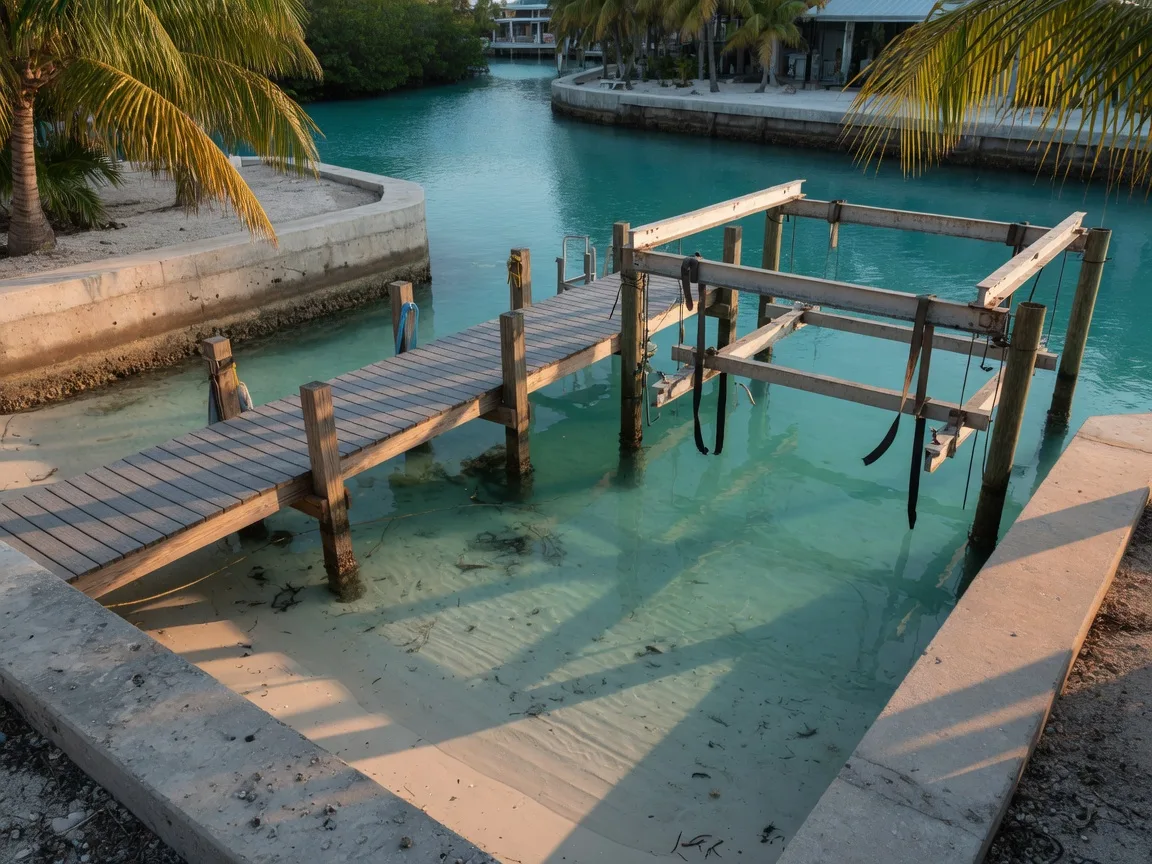
The seawall is the most expensive repair a waterfront home can require, and the dock is the most used piece of equipment a boat owner owns. Both deserve the same inspection attention as the roof and the foundation. As a licensed Florida contractor and home inspector, I look at the seawall for cracking, tilting, spalling, and signs the tie-backs are failing, because a wall that begins to lean is a replacement project measured in six figures. The dock gets the same scrutiny: pilings, decking, electrical, and whether the structure was built for the loads you intend to put on it.
A dock built for jet skis and a kayak will not comfortably hold a 30,000-pound yacht on a lift, and upgrading a dock can require county permitting and months of lead time. If the property already has a lift, verify its rated capacity, its age, and its condition before you treat it as an asset. My seawall and dock inspection guide for Keys buyers walks through exactly what to check, and it is worth reading before your first offer.
Boat Lifts, Davits, and the Rules of the Water
Once the water and the structure work, the rules decide what you can actually do with them. Many Keys communities operate under a homeowners association, and the entire island chain sits within an Area of Critical State Concern, often shortened to ARCO, which puts extra county scrutiny on new construction and changes along the shoreline. That means permits for a new lift, an extended dock, or a change to your shoreline belong in the process before you sign, not after you close.
The practical translation: confirm in writing what dockage setup the property will support, and what the association or county will allow you to change. Some communities limit the number of lifts, the size of davits, or the use of a dinghy dock. My guide to HOA and ARCO covenants for Keys waterfront buyers covers the questions to ask, and it applies just as much to a boat owner as to anyone buying a canal lot.
Make Water Depth Part of the Offer
A buyer in the Keys can protect the entire premise of the purchase with one clause: a water-depth contingency. The offer states that the canal must hold a specified depth at mean low water at the dock and in the approach, verified by a survey the buyer commissions within a defined window. If the survey comes back short, the buyer can renegotiate or walk. This is standard practice in knowledgeable transactions, and the sellers who balk at it are usually the ones with something to hide under the waterline.
The same logic applies to the lift and the dock. Write the capacity you need into the contingency list, and verify the electrical service at the dock can run a modern lift. When you are ready to negotiate, my guide to making a competitive offer on a Keys waterfront home lays out how to structure these protections without losing the deal.
Insurance and Hurricane Season Belong in the Budget
Owning a boat at your Keys home means taking hurricane season seriously, because the investment sitting on your lift deserves the same protection as the house. The routine is well established: keep the boat hauled, strapped, and securely tied in a sheltered slip, or move it to a protected basin before a storm. Buyers who plan for this from the start choose properties with a hurricane plan in place, a harbor of refuge nearby, or a marina that can haul their vessel.
Insurance follows the same logic. Your homeowners policy, your flood coverage, and your marine policy are separate conversations, and the configuration of your dockage affects all of them. My insurance and flood zone guide for Keys buyers covers the home side, and it pairs with your marine insurer for the boat side. Add both to the budget before you make an offer, and the numbers will not surprise you later.
Build Your Community Shortlist
With your boat's numbers in hand, the search narrows fast. Key Largo offers deep canals with direct Atlantic access through well-known passes, and it is the natural first stop for boat owners coming down U.S. 1. Tavernier adds the dual-side advantage of Tavernier Creek, with routes to both the Atlantic and the bay. Islamorada is the sportfishing capital, where the community calendar revolves around the water. Marathon, further down the chain, brings full-service marinas, haul-out yards, and the amenities of the Middle Keys. Each community has its own deep-water pockets, and my Key Largo luxury waterfront community guide is a good place to start comparing.
The final step is the part no listing can show you: the neighborhood on the water. Talk to the people at the dock, watch the canal at low tide, and ask the marina how boats are stored here in season. The best waterfront street in the Keys is the one where the neighbors treat the water as shared infrastructure, because that is the community you are really buying into. My complete Florida Keys buyer's guide pulls the whole process together, and when you are ready to tour, call Steve Conley at (305) 393-5859 and we will run the numbers on your shortlist together.
Your boat,
your buying questions.
How much boat can a Florida Keys canal home realistically accommodate?
It depends entirely on the canal. Deep-water canals that hold five feet or more at mean low water can accommodate sportfishing yachts, while shallower canals suit center consoles and smaller vessels. Your boat's draft is the deciding number, and the only reliable way to know is a depth survey at the dock and at the canal entrance.
Can I verify canal depth before making an offer?
Yes. Ask the seller or canal association for a recent depth survey, and where none exists, commission one as part of your due diligence. The smart buyer adds a water-depth contingency to the offer, so the purchase price stands or falls on what the survey actually shows.
Do I need a permit for a boat lift or davits in the Keys?
Almost always. New lifts, extended docks, and shoreline changes fall under county permitting, and community associations or ARCO rules add another layer of review. Confirm the approved configuration in writing before you close, so you know exactly what dockage you are buying.
Should I buy a home with a boat lift already installed?
Only if the lift fits your boat. Verify the rated capacity against your vessel's weight, check the age and condition, and confirm the dock electrical service can run it. A lift that is too small is a decommissioning project, and a replacement lift with a new dock can be a significant line item.
What is a hurricane hole, and why does it matter to boat-owning buyers?
A hurricane hole is a protected basin, canal, or harbor used to shelter boats during tropical storms. Communities with a good hurricane hole, or marinas that can haul vessels, give boat owners a reliable plan for storm season, which is why buyers who boat for a living weigh it as heavily as they weigh the house itself.
Helpful Resources & Related Guides
Deepen your understanding of the Florida Keys waterfront buying process, dockage value, and boating lifestyle with these related resources.
Internal Resources
- Key Largo Luxury Waterfront Community Guide
- Deep-Water Canal Investment in Key Largo: Why Boating Access Drives Value
- Seawall and Dock Inspection Guide for Florida Keys Waterfront Buyers
- How to Make a Competitive Offer on a Florida Keys Waterfront Home
- How to Buy a Luxury Waterfront Home in the Florida Keys
- Contact Steve Conley about Boat-Ready Waterfront Homes

Steve Conley
Principal, Conley Sales Group at COMPASS, the exclusive Compass office in the Florida Keys. Licensed Sales Associate, Contractor, and Home Inspector with over 30 years and $1.4 billion in career sales serving the island chain.
Full Bio
Thinking About Buying or Selling
in the Florida Keys?
Steve Conley brings 30 years of Keys expertise, $1.4 billion in career sales, and contractor-inspector credentials to every transaction. Start with a conversation about your boat and your budget.
Connect with Steve