
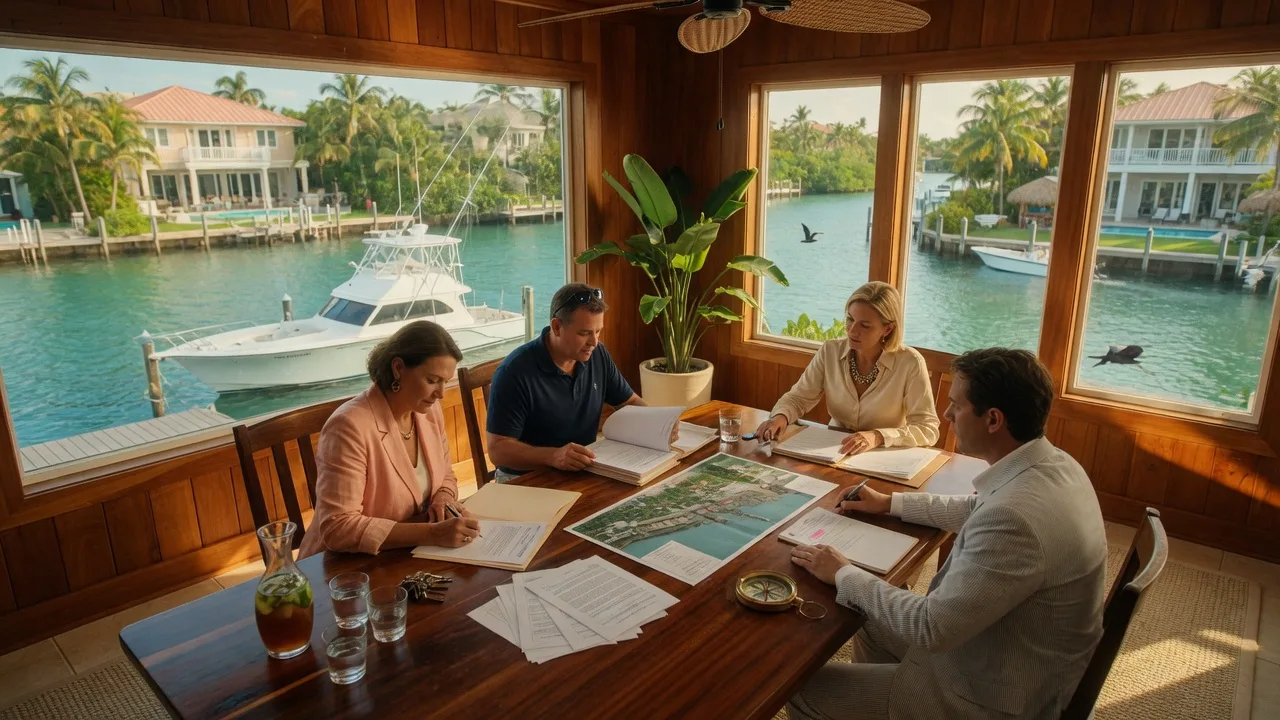
Title Search, Survey, and Closing Mechanics for Florida Keys Waterfront Properties
The final stages of a Keys waterfront purchase involve specialized title work, surveys, and closing procedures unique to island properties. Here is what every buyer should understand before they sign.
Key Takeaways
- The title search for a Florida Keys waterfront property must account for unique encumbrances such as submerged land rights, navigational easements, dock permits, and Association of Recreational and Conservation Organizations (ARCO) lease agreements that do not exist in most real estate transactions.
- A boundary survey is essential for Keys waterfront property and must include mean high water line determinations, seawall location confirmation, and any encroachments that could affect title or insurability.
- Closing costs in the Keys often exceed 3 to 5 percent of the purchase price, with title insurance premiums, survey fees, documentary stamp taxes, and recording fees forming the largest components.
- Understanding the difference between fee simple ownership of the land and leasehold interests in submerged land beneath certain canals is critical for evaluating long-term property value and transferability.
- Title insurance is not optional for financed waterfront purchases, and the owner's policy should include comprehensive coverage for waterfront-specific risks such as accretion, avulsion, and littoral rights disputes.
The final stretch of buying a Florida Keys waterfront property from accepted offer to closing day is where the transaction gets its definition. While the offer and inspection stages get the most attention in real estate guides, the closing phase is where the technical, legal, and financial details of the purchase are settled. And in the Keys, those details are anything but standard. Over three decades of guiding buyers through Keys closings, I have seen waterfront transactions derail at the eleventh hour because of issues that a prepared buyer could have anticipated. This guide covers the title search, survey, closing mechanics, and everything in between.
The process begins the moment your offer is accepted and the contract is signed. From that point, the clock starts on a series of parallel tracks: the title company begins its work, the surveyor schedules a site visit, the lender processes your application, and the insurance broker starts securing quotes. In a well-run transaction, all of these tracks converge on closing day with no surprises.
The Title Search: More Than Just Ownership Records
A standard title search traces the chain of ownership and identifies any liens, judgments, or encumbrances on the property. In the Florida Keys, the title search goes deeper. It must account for the unique legal framework that governs waterfront property, including sovereign submerged lands, navigable waterways, and littoral rights.
Sovereign submerged lands. In Florida, the state owns the lands beneath navigable waters, including many of the canals and waterways that provide access to the ocean or Florida Bay. When you buy a canal-front property in the Keys, you may own the land to the edge of the canal, but the submerged land beneath the canal itself may be sovereign land subject to a lease from the state. This distinction matters because it affects your rights to maintain a dock, dredge a channel, or install shoreline improvements. The title search should reveal any existing sovereign land leases, and your title attorney should explain their terms and transferability.
Navigational easements and access rights. Some properties in the Keys are subject to navigational easements that grant access to neighboring properties across the water. These easements are recorded in the public records and should be identified during the title search. An easement that allows a neighbor to cross your canal frontage to reach deeper water could affect your privacy and your ability to install certain waterfront improvements.
Dock permits and licenses. If the property has an existing dock, the title search should confirm that all required permits from the Army Corps of Engineers, the Florida Department of Environmental Protection, and Monroe County have been obtained and are in good standing. Unpermitted dock improvements are a common issue in older Keys waterfront properties, and they can create title defects that affect the property's marketability.
ARCO leases. The Association of Recreational and Conservation Organizations, or ARCO, manages certain leasehold interests in submerged lands in the Keys. Some canal properties include leasehold interests to the submerged land beneath the canal, which must be transferred to the new owner as part of the sale. The title search should confirm the status of any ARCO lease agreements.
Your title company and real estate attorney should work together to review these issues before closing. On waterfront transactions, I advise my clients to use a title company that has specific experience with Florida Keys waterfront properties. A national title company that primarily handles suburban residential closings may miss the nuances of sovereign submerged lands and littoral rights. For a broader view of the entire buying process, start with my guide to Navigating the Florida Keys Luxury Home Buying Process.

The Survey: Establishing Boundaries on the Water
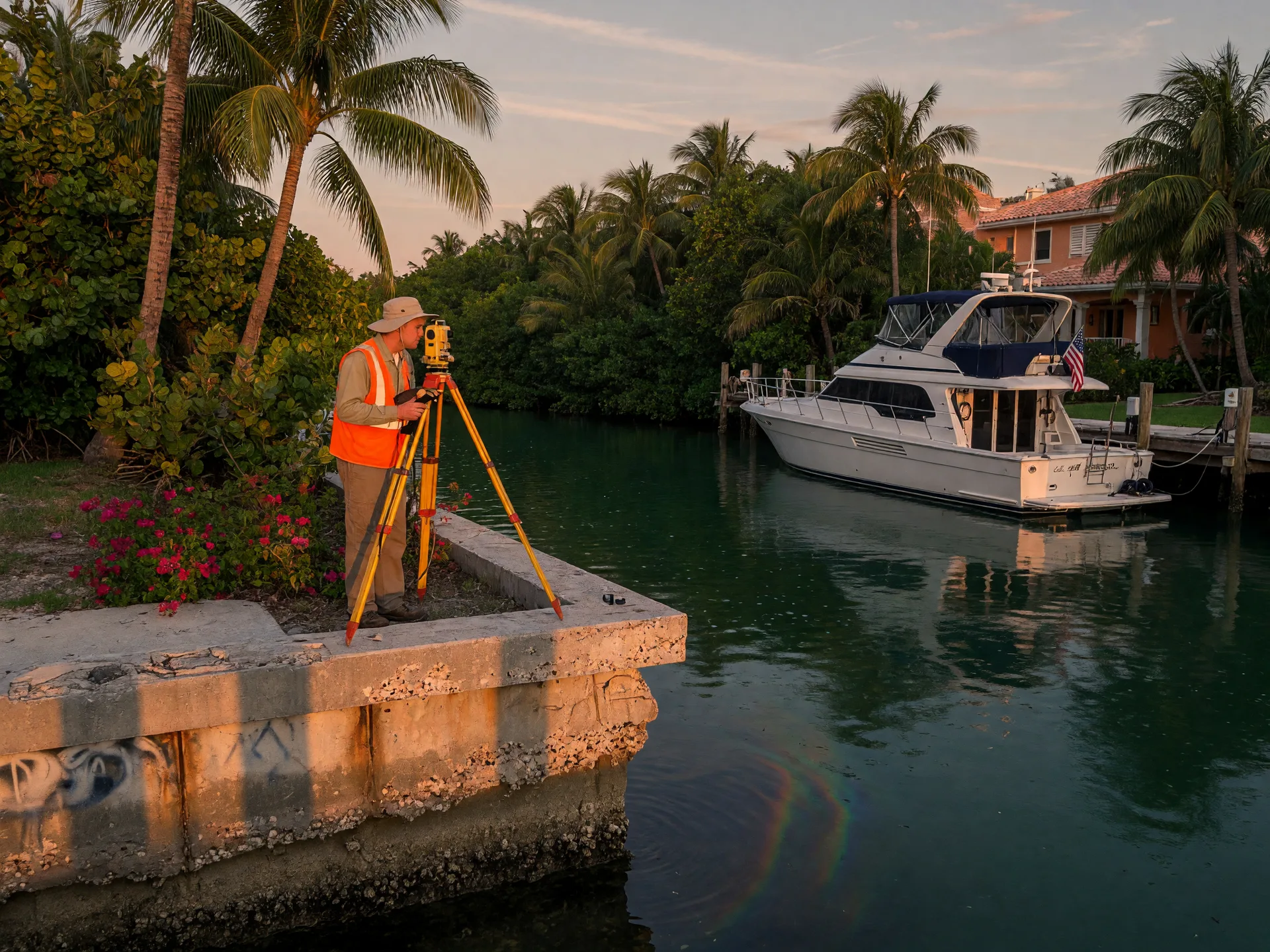
A boundary survey is a requirement for almost every financed waterfront purchase in the Keys. Lenders want to know exactly what they are lending against, and buyers want to know exactly what they are buying. But a waterfront survey in the Keys is not the same as a standard residential survey.
The survey for a Keys waterfront property must establish the following.
- The mean high water line. This is the line where the ordinary high tide reaches the shore, and it establishes the boundary between the upland property and the sovereign submerged lands. The mean high water line is a legal boundary that affects the property description, and it must be surveyed by a licensed Florida surveyor with experience in tidal boundaries.
- The seawall line. For properties with seawalls, the survey should show the seawall location relative to the property boundaries. If the seawall is constructed beyond the property line or encroaches onto neighboring land, that is a title defect that must be addressed before closing.
- Structures and improvements. All structures on the property, including the home, guest house, pool, dock, boat lift, and any other improvements, must be located on the survey and shown to be within the property boundaries.
- Encroachments. The survey should identify any encroachments by neighbors onto the property, or by the property onto neighboring land. Common waterfront encroachments include docks that extend beyond the property line, seawalls that cross onto adjacent land, and landscaping that intrudes into easements.
- Access and ingress-egress. The survey should confirm that the property has legal access to a public road and that the driveway is within the property boundaries. Some Keys waterfront properties have access easements across neighboring land that must be documented.
I recommend that every buyer review the survey with their agent and attorney before closing. As a licensed contractor, I also review surveys for potential construction issues, such as whether the building envelope allows for planned renovations or whether the setback lines permit a pool or dock expansion.
Closing Costs: What to Expect
Closing costs in a Florida Keys waterfront transaction are higher than in a typical residential sale, for several reasons. The purchase price is higher, the title work is more complex, the survey is more detailed, and the insurance requirements are unique. Here is a breakdown of the major closing costs and what you can expect to pay.
Title insurance premium. Owner's and lender's title insurance policies are required for financed transactions. The premium is a one-time cost paid at closing, and it is based on the purchase price. For a $2 million waterfront property, the combined title insurance premium typically ranges from $8,000 to $12,000. The cost is higher than a standard policy because it must cover the additional risks associated with waterfront property, including sovereign land claims, littoral rights disputes, and unpermitted improvements.
Survey fee. A full boundary survey for a waterfront property in the Keys typically costs $1,500 to $3,500, depending on the property size and complexity. This is higher than a standard residential survey due to the need for tidal boundary determination, underwater topography, and detailed seawall and dock locations.
Documentary stamp taxes. Florida imposes a documentary stamp tax on the deed and any notes or mortgages associated with the transaction. The rate is 70 cents per $100 of consideration for the deed and 35 cents per $100 for the note. On a $2 million transaction, the documentary stamp taxes total approximately $14,000 to $21,000.
Recording fees and intangible taxes. Monroe County recording fees and Florida intangible taxes on new mortgages add several hundred to a few thousand dollars to the closing costs, depending on the loan amount.
Attorney fees. While not required, many buyers in the luxury segment choose to have their own real estate attorney review the closing documents. Attorney fees for a waterfront closing typically range from $2,500 to $5,000.
Prepaids and escrows. You will need to prepay property taxes, insurance premiums, and sometimes association dues at closing. For a luxury waterfront property, the prepaids can be substantial, particularly for insurance, which may be $8,000 to $15,000 or more for the first year.
In total, closing costs on a $2 million Keys waterfront property typically range from $60,000 to $100,000, or 3 to 5 percent of the purchase price. Your lender will provide a Closing Disclosure document three business days before closing that itemizes every cost. Review it carefully with your agent and attorney.
The Closing Day Experience
Closing day in the Florida Keys is handled much like any other real estate closing, with a few local differences. The closing agent will present the documents for your signature, and the funds will be wired to the title company. Here is what to expect on the day itself.
Where the closing happens. In the Keys, closings typically take place at the title company's office, the attorney's office, or the real estate brokerage. Remote closings using a mobile notary or remote online notarization have become more common and are now permitted under Florida law for real estate transactions.
Documents to sign. You will sign the settlement statement, the promissory note, the mortgage or deed of trust, the deed (as the buyer, you do not sign the deed, but you will receive a copy), and various affidavits and disclosures. The closing agent will explain each document before you sign.
Funds to bring. Your down payment and closing costs must be wired to the title company's escrow account before or at the closing. Certified funds are not typically used for amounts over $50,000; wire transfers are the standard method for luxury transactions.
Keys and possession. Unless the contract specifies a post-closing occupancy period, you receive the keys and take possession at closing. The deed is recorded with the Monroe County Clerk of Court, typically within 24 to 48 hours after closing.
Throughout the closing process, I am present for my clients to answer questions, review documents, and ensure that everything goes smoothly. It is the culmination of weeks or months of work, and it should feel seamless when it is done right. For personalized guidance through your own transaction, contact Steve Conley.

Steve Conley
Principal, Conley Sales Group at COMPASS the exclusive Compass office in the Florida Keys. Licensed Sales Associate, Contractor, and Home Inspector. Over 30 years and $1.4 billion in career sales serving Key Largo to Key West.
Full BioTitle, survey, and closing:
what to know.
What is sovereign submerged land and why does it matter for my purchase?
In Florida, the state owns the land beneath navigable waterways. When you buy a canal-front property, you may own the land to the canal edge, but the submerged land under the water may be subject to a state lease. This affects your rights to maintain a dock, dredge a channel, or install shoreline improvements. Your title search will reveal any existing leases or encumbrances related to sovereign submerged lands.
Do I need a survey for a Florida Keys waterfront property?
Yes, almost every financed waterfront purchase requires a boundary survey. The survey must establish the mean high water line, confirm seawall and dock locations, identify any encroachments, and document all structures on the property. A survey for a Keys waterfront property costs $1,500 to $3,500 and takes two to four weeks to complete, so order it early in the process.
What closing costs should I expect for a Keys waterfront home?
Closing costs typically run 3 to 5 percent of the purchase price in the luxury segment. For a $2 million property, expect $60,000 to $100,000 in total closing costs, including title insurance ($8,000 to $12,000), survey fees ($1,500 to $3,500), documentary stamp taxes ($14,000 to $21,000), recording fees, attorney fees, and prepaids for taxes and insurance.
Can I close remotely on a Keys waterfront property?
Yes, remote online notarization is permitted under Florida law for real estate transactions, and many out-of-state buyers close on Keys properties remotely. Your title company or attorney can coordinate a remote closing using a licensed Florida notary or an approved remote online notarization platform. Your agent can be present in person or join via video conference.
What happens if the title search reveals an issue?
If the title search discovers an encumbrance such as an undisclosed lien, an unpermitted dock, or a boundary dispute, the title company will work with the seller to resolve it before closing. Common resolutions include obtaining a release of lien, acquiring permits for unpermitted improvements, or negotiating a price adjustment. The buyers purchase and title insurance policies protect you if issues arise after closing. If you have questions about a title issue on a property you are considering, contact me directly.
Helpful Resources & Related Guides
Deepen your understanding of the Florida Keys home buying process with these related resources.
Internal Resources
- How to Buy a Luxury Second Home in the Florida Keys
- Key Largo Luxury Waterfront Community Guide
- Navigating the Florida Keys Luxury Home Buying Process
- The Complete Florida Keys Waterfront Property Inspection Checklist
- Understanding Insurance and Flood Zone Requirements
- Florida Keys Luxury Real Estate Market Report
- Contact Steve Conley for Personalized Closing Guidance

Thinking About Buying or Selling
in the Florida Keys?
Steve Conley brings 30 years of Keys expertise, $1.4 billion in career sales, and contractor-inspector credentials to every transaction. Start with a conversation.
Connect with Steve